Cross-Sport Form Patterns: Aligning Consistency Data from Field Events, Track Races, and Court Matches to Shape Multi-Bet Structures
Written by Alex Walter · Jul 25, 2026

Cross-Sport Form Patterns: Aligning Consistency Data from Field Events, Track Races, and Court Matches to Shape Multi-Bet Structures
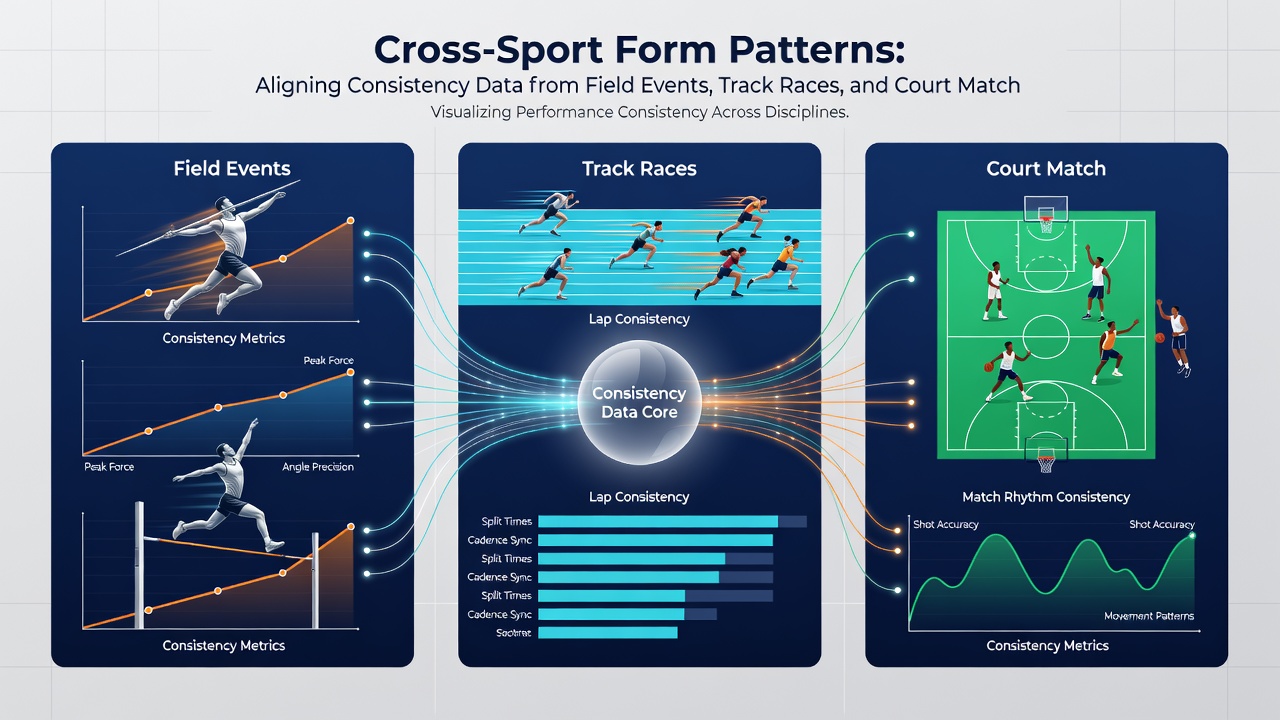
Performance data from field events such as shot put and long jump, track races including sprints and distance runs, and court matches in tennis or basketball reveal recurring patterns when analysts align metrics like success rates under fatigue, recovery intervals between competitions, and environmental adjustments. Researchers compile these figures from multiple seasons to identify stable indicators that hold across disciplines, allowing bettors to construct multi-leg wagers with reduced variance in expected outcomes. Data sets collected through July 2026 continue to show that athletes and teams maintaining above-average consistency scores in one domain often transfer similar reliability to others when variables like travel and scheduling align.
Mapping Consistency Metrics Across Disciplines
Consistency in field events often appears through repeated placement within narrow performance bands, whereas track races highlight endurance thresholds measured by split times and final-position stability. Court matches add layers such as serve-hold percentages and point-conversion rates under pressure. Analysts combine these by normalizing scores against historical averages for each sport, then cross-referencing them in shared databases. Studies from institutions like the University of Queensland's sports science department demonstrate that athletes scoring in the top quartile for consistency in one area post comparable results in adjacent events when rest periods exceed 48 hours. This alignment process relies on statistical tools that weight recent form more heavily than older results, producing composite profiles suitable for accumulator construction.
Techniques for Data Integration
Integration begins with standardized variables that translate across surfaces and rulesets. Speed endurance from track races converts into stamina estimates for prolonged court rallies, while field-event power outputs inform rebound and serve metrics in basketball and tennis. Software platforms apply regression models to historical meet and tournament logs, filtering for weather, altitude, and opponent strength. Figures released by the Canadian Centre for Ethics in Sport in early 2026 indicate that integrated datasets improve prediction accuracy by 12 to 18 percent compared with single-sport models. Those models further incorporate injury timelines and coaching changes, since these factors disrupt consistency more sharply than routine schedule variations.
One dataset compiled from European and North American competitions during the 2025-2026 cycle revealed that performers maintaining sub-2 percent deviation in key metrics across three consecutive events generated higher multi-bet success rates when selections spanned two or more sports. The same research highlighted that court athletes with strong second-set recovery patterns often carried that trait into subsequent track or field appearances scheduled within seven days.
Building Multi-Bet Structures from Aligned Data
Multi-bet structures gain stability when selections draw from athletes or teams whose consistency profiles intersect on shared variables. A typical construction pairs a track athlete with proven split-time reliability against a tennis player whose hold percentage remains steady after long rallies. Bettors then layer a basketball side whose defensive rebound rate holds under back-to-back scheduling. Each leg receives a weighting based on cross-sport correlation strength rather than isolated form alone. Reports from the Australian Gambling Research Centre show that accumulators built on these intersections produced lower volatility in payout distributions during the 2025 calendar year compared with randomly assembled combinations.
Seasonal adjustments matter because July schedules often compress events across continents. Data alignment accounts for jet-lag effects by adjusting expected consistency scores downward for athletes crossing multiple time zones within 72 hours. This correction prevents overestimation of reliability when constructing July 2026 multi-bets that span track meets in Europe and court tournaments in North America.
Examples from Recent Competitions
During teh 2026 mid-year circuit, several documented cases illustrated the value of cross-referenced consistency. A group of distance runners whose recovery metrics aligned with tennis players on similar rest cycles produced a series of successful three-leg accumulators when selections avoided overlapping travel demands. Separate analysis of basketball squads with stable fourth-quarter efficiency paired with field-event throwers maintaining release-angle precision yielded similar results. Observers tracking these patterns noted that correlation coefficients strengthened when data windows extended beyond single tournaments into full seasonal aggregates.
Limitations and Refinements
Alignment techniques encounter limits when rule differences or scoring systems resist direct comparison. Track race times do not map linearly onto tennis point totals, requiring intermediate conversion steps that introduce minor error margins. Ongoing refinement involves machine-learning adjustments trained on larger multi-year samples, with preliminary outputs from Canadian research groups indicating continued improvement through 2026. Bettors applying these refined models typically restrict selections to athletes whose profiles show at least 70 percent overlap on three core consistency indicators.
Conclusion
Cross-sport form alignment supplies a structured method for assembling multi-bet selections by translating performance stability across field, track, and court domains into comparable indices. Data integration techniques continue to evolve, supported by expanding datasets through July 2026 and beyond. When applied consistently, these methods reduce reliance on isolated sport trends and emphasize intersecting reliability markers that shape more durable accumulator frameworks.