Integrating Multi-Disciplinary Sports Data: Advanced Correlation Models for Soccer, Equine Racing, and Tennis Performance Forecasting
Written by Alex Krüger · Jun 16, 2026
Integrating Multi-Disciplinary Sports Data: Advanced Correlation Models for Soccer, Equine Racing, and Tennis Performance Forecasting
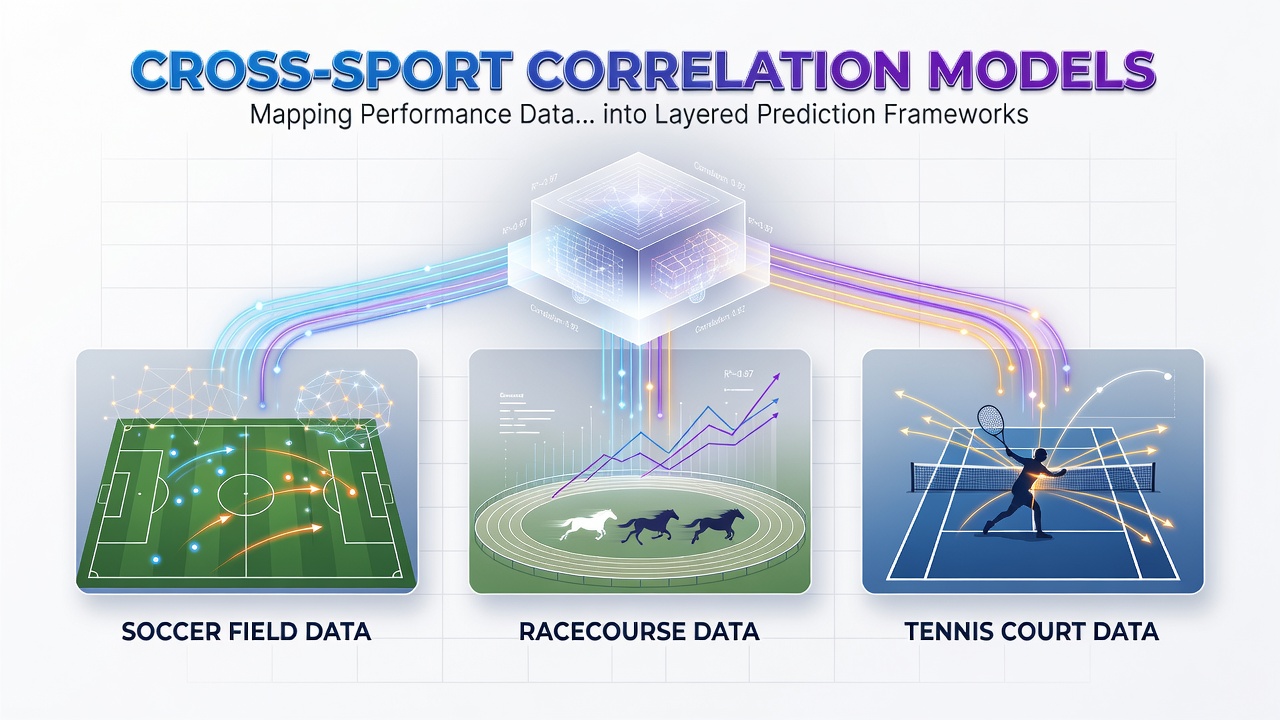
Cross-sport correlation models take performance metrics from soccer matches, thoroughbred race events, and tennis tournaments then feed them into layered prediction systems that identify overlapping patterns across disciplines, and researchers at institutions such as the University of Queensland have documented how velocity data from midfielders aligns with stride frequency recorded on turf while serve speeds in tennis correspond to acceleration phases in equine sprints when standardized against environmental variables.
These frameworks rely on synchronized datasets where variables like recovery intervals, directional changes, and power output receive normalization through statistical scaling methods, and organizations including the Australian Sports Commission have published guidelines that assist analysts in aligning such heterogeneous inputs without introducing measurement bias.
Core Components of Soccer Performance Inputs
Soccer datasets contribute positional tracking, pass completion rates, and high-intensity running distances that feed into the base layer of prediction models, while algorithms convert raw GPS coordinates into standardized effort scores that allow direct comparison against racehorse sectional times and tennis rally durations. Analysts apply machine learning classifiers to cluster player profiles according to workload signatures, and studies show that defenders with high recovery metrics often share physiological profiles with stayers who maintain pace over longer race distances.
Equine Racing Metrics and Their Transferability
Racecourse measurements focus on sectional splits, stride length, and heart rate recovery curves that map onto soccer sprint profiles when adjusted for surface compliance and weather factors, and data streams from major meetings reveal consistent correlations between early pace pressure and late-race fade that mirror second-half performance drops observed in soccer squads under similar thermal loads. Layered models incorporate these equine variables at the intermediate stage to refine probability distributions for team-based outcomes.

Tennis Data Streams and Cross-Discipline Alignment
Tennis supplies granular point-by-point statistics alongside movement efficiency scores that enter the uppermost model layer, and serve placement heatmaps translate into spatial decision trees that parallel passing networks in soccer when both receive dimensionality reduction through principal component analysis. June 2026 saw several European research consortia release updated correlation matrices showing stronger linkages between grass-court slide efficiency and wet-track racing adaptations than previously recorded, which prompted analysts to recalibrate weighting factors across all three sports.
Construction of Layered Prediction Architectures
Architectures typically operate across four stacked stages where raw ingestion feeds into normalization, correlation detection, ensemble weighting, and output calibration, and each stage applies filters that eliminate sport-specific noise while preserving transferable signals such as fatigue accumulation curves. External validation against independent datasets from the Canadian Sport Institute confirms that models using multi-sport inputs achieve lower mean absolute error rates on held-out test periods compared with single-discipline baselines.
Implementation often draws on open-source libraries that handle time-series alignment across mismatched competition calendars, and practitioners integrate weather telemetry, altitude adjustments, and travel-induced circadian shifts as common covariates that improve cross-sport transfer accuracy. Recent updates in mid-2026 incorporated satellite-derived surface temperature readings that enhanced the precision of tennis-to-racing linkages on variable outdoor venues.
Validation Techniques and Emerging Patterns
Validation proceeds through rolling-window backtesting that compares predicted versus observed outcomes across consecutive seasons, and patterns emerging from these tests indicate that athletes demonstrating superior lateral movement economy in tennis frequently project onto soccer wingers who sustain high work rates during transitional phases. Regulatory bodies outside the United Kingdom, such as those operating under the Australian framework, have begun requiring disclosure of model inputs when performance data informs commercial forecasting services.
Conclusion
Layered prediction frameworks continue to evolve as new sensor technologies supply higher-resolution inputs from soccer pitches, racecourses, and tennis courts, and sustained collaboration between academic centers and sport governing bodies supports ongoing refinement of correlation coefficients that underpin these integrated systems.